Future-Proof Your SEO with AEO: Winning in AI, Voice and Zero-Click Search
Over half of Google searches now end in zero clicks, with answers delivered directly on the results page instead of through a website visit. In this installment of our “New Frontiers of SEO” series, we dive into Answer Engine Optimization (AEO) — the practice of structuring content so your brand becomes the definitive answer. From AI-powered search tools and voice queries to featured snippets and zero-click experiences, AEO ensures your content stays visible, trusted and top of mind in an evolving search landscape.
The way people search has changed… and it’s changed fast.
Where once users typed in simple keyword phrases like “best forklifts,” today they’re asking nuanced, full-sentence questions like “What’s the best forklift for a high-traffic warehouse with minimal aisle width?” And increasingly, they expect a direct, immediate answer – without clicking anywhere.
That shift has ushered in a new phase of search: one where visibility depends not just on keyword rankings, but on being the answer.
Enter: Answer Engine Optimization (AEO). A new evolution in SEO, AEO helps your brand surface in the places people are now asking their questions: voice assistants, AI-powered search tools, featured snippets and zero-click results.
And the momentum behind this shift is only growing:
- A stunning 58.5% of Google searches result in zero clicks. Users find their answers directly on the search engine results page (SERP) without visiting a website.
- Meanwhile, 55% of teens and 41% of adults use voice search more than once a day. Voice-enabled devices are expected to reach 8.4 billion units globally by the end of 2025 — outnumbering the global population.
- And AI-driven search tools like Google SGE, Bing Copilot and ChatGPT with browsing are already shaping how answers are presented and who gets the spotlight.
So, what does that mean for your brand?
It means if your content isn’t structured to answer real questions in the ways search engines and AI assistants prefer, you’re missing key opportunities for visibility, authority and conversion.
In this second installment of our New Frontiers of SEO series, we’ll unpack the essentials of AEO — what it is, why it matters and how to craft an optimization strategy that positions your brand as the answer across the evolving digital landscape.
What is Answer Engine Optimization (AEO)?
Answer Engine Optimization (AEO) is the practice of creating content that gives clear and reliable answers to users’ questions that can be found by search engines, voice assistants, and AI tools. It’s about making your brand the definitive response at the moment someone needs help, even if they never click through to your site.
If traditional Search Engine Optimization is about climbing the rankings and Generative Engine Optimization (GEO) is about feeding content into generative AI, then AEO is about being the definitive answer — clear, concise and structured in a way that machines and people alike can instantly understand.
In an AI-first world, people are no longer searching the way they used to. And that means brands can’t afford to optimize like it’s 2015. AEO is the natural evolution of search strategy, where context and authority outweigh keyword density and backlinks alone.
The Evolving State of Search
The demand for immediate answers is growing and search engines have effectively become answer engines. Between rich snippets, voice assistants and conversational AI experiences, users increasingly receive summarized, contextualized responses without ever clicking through to a website.
Modern search experiences increasingly revolve around immediate answers. From Google’s featured snippets and “People Also Ask” panels to ChatGPT’s generative search, users expect instant clarity. At the same time, voice assistants like Siri, Alexa and Google Assistant depend on content optimized for spoken queries.
Rather than replacing traditional SEO, emerging practices like AEO, GEO and SXO are complementary layers that allow SEO to perform across more diverse and intelligent discovery systems. They represent a more holistic, modern approach to search built around usefulness, clarity and experience.
If SEO Is About Visibility…
- AEO (Answer Engine Optimization) is about immediate utility. It focuses on being the single, direct solution that a voice assistant or AI snippet reads aloud, removing the need for a click entirely.
- GEO (Generative Engine Optimization) is about citation and influence. It focuses on convincing generative AI models (like Google’s AI Overviews or Perplexity) to trust your brand enough to recommend it, cite it or weave it into their synthesized summaries.
- SXO (Search Experience Optimization) is about user satisfaction. It combines SEO with User Experience (UX), acknowledging that getting a user to the site is useless if they leave immediately because the page is slow, confusing or just plain ugly.
If People Aren’t Clicking, Why Should You Bother With AEO?
The biggest objection to Answer Engine Optimization is obvious: “If the AI gives the answer, nobody visits my website. Why should I help ChatGPT steal my traffic?”
It’s a valid fear. But in the new era of search, we have to shift our mindset from chasing traffic to building influence. Here is why AEO is critical, even in a “zero-click” world:
- The “Digital Billboard” Effect: Think of an AI answer like a highway billboard. The driver might not pull over (click) right now, but they see your brand cited as the expert. When a user asks, “What’s the best running shoe?” and the AI says, “According to [Your Brand]…” you are building massive brand awareness and mental availability for when they are ready to buy.
- The Ultimate Endorsement: We are psychologically wired to trust third-party recommendations. Traditional SEO is you telling the world, “I am an expert.” AEO is an intelligent machine telling the user, “This brand is the expert.” That is a high-tech referral that builds instant trust.
- The Defensive Play: The AI will answer the question. The only choice you have is whether it cites you or your biggest competitor. By ignoring AEO, you aren’t saving your traffic — you are simply handing the microphone to someone else.
- Voice Search is “Winner Take All”: When someone asks Siri or Alexa a question, there is no page two. There isn’t even a result #2. The device reads one answer. If you aren’t optimized for AEO, you are effectively invisible to voice search users.
The Bottom Line: Traditional SEO captures the visit; AEO captures the narrative. You need both to win.
Building Your AEO Strategy: A 5-Step Roadmap
Successful AEO starts with understanding one thing: your audience is asking real questions and they expect real answers fast. Whether they’re speaking to a smart device, typing a question into Google or exploring results through AI assistants, your content needs to be the most accessible and trusted response available.
Here’s how to make that happen…
1. Identify the Questions Your Audience is Asking
It all starts with knowing your audience’s pain points and curiosities. Use tools like Answer the Public, AlsoAsked, Google Search Console and Semrush’s Question Keywords tool to discover what people are really asking in your niche.
Go a step further: mine your customer support tickets, live chat transcripts, sales team feedback and internal site search logs to uncover recurring questions. These real-world insights can help you craft content that reflects the language and concerns of your audience.
2. Create Precise, Structured Content
Answer first, elaborate second. When a user (or voice assistant) scans your content, they should find the answer within the first 1–2 sentences. Don’t bury the lede.
Use formatting that supports clarity:
- Bullet points for step-by-step instructions
- Short paragraphs with clear subheadings
- Definition boxes and TL;DR summaries
- Dedicated FAQ sections
3. Implement Schema Markup and Structured Data
Help machines help you. Implement structured data (like FAQPage, HowTo and QAPage schemas) using JSON-LD to tell Google and other engines what your content is and how it should be understood.
This is what powers rich results, featured snippets and voice responses. Tools like Google’s Rich Results Test and Schema.org can guide your implementation.
4. Establish Topical Authority
Don’t just answer one question; build an ecosystem of related answers. Group content into topic clusters using internal links and cornerstone pages.
For example, if you’re writing about Medicare Advantage plans, link to related FAQs, state-specific info and definitions of key terms like formulary, premium and deductible. This web of interconnected content tells search engines you’re the expert.
5. Optimize for Voice and Conversational AI
Voice queries tend to be longer, more conversational and more context-rich. To rank in voice search or get pulled into AI-generated answers, use:
- Natural, question-style headings (e.g., “What does umbrella insurance cover?”)
- Clear, jargon-free language that sounds natural when spoken aloud
- Short, spoken-length responses (20–30 words for voice results)
Pro-Tip: Try reading your content out loud. If it sounds like something Alexa or Siri could say, you’re on the right track.
The Future Belongs to the Answer-Ready
Search behavior is changing faster than ever, and so is the technology delivering those results. Whether it’s AI-generated summaries, voice assistants or zero-click SERPs, today’s users want fast, clear and accurate answers.
That means the brands that win won’t just be those who rank. They’ll be the ones who respond — intelligently, conversationally and consistently.
Answer Engine Optimization (AEO) is your opportunity to meet users at that critical moment of curiosity with content that speaks their language and solves their problem. When paired with modern SEO strategies like GEO and SXO, you’re not just chasing traffic, you’re building trust, authority and a future-proof search presence.
Become the Answer Your Customers Have Been Searching For
Let’s make sure your SEO strategy aligns with where search is heading, not just where it’s been. The Responsory team can help you build a customized roadmap that balances rankings, reach and relevance across all the emerging frontiers of SEO. From schema markup and FAQ development to voice search optimization and AI-ready content, we’ll help you win the new search landscape.
Contact us today to start building a smarter, AI-ready, answer-driven content strategy – with or without the click.
In This Blog
1. Introduction
2. What is AEO?
3. Evolving State of Search
4. Building an AEO Strategy
5. How We Can Help
Free Infographic
FROM THIS SERIES

About the Author
A lifelong dinosaur enthusiast and lover of old things, Aimee Dierbeck aspired to become a museum curator from a young age. As a bright-eyed intern at a local museum, she realized that her true passion for museums did not lie in the artifacts or fossils themselves but in the stories they told and how these stories were communicated to the public. From this revelation, her academic interests and subsequent career took a significant turn into marketing, graphic design, copywriting, content strategy and, eventually, web strategy. In her role as AVP of Digital & Web Services, Aimee draws on her love for storytelling and digital curiosity to curate intentional, impactful experiences.
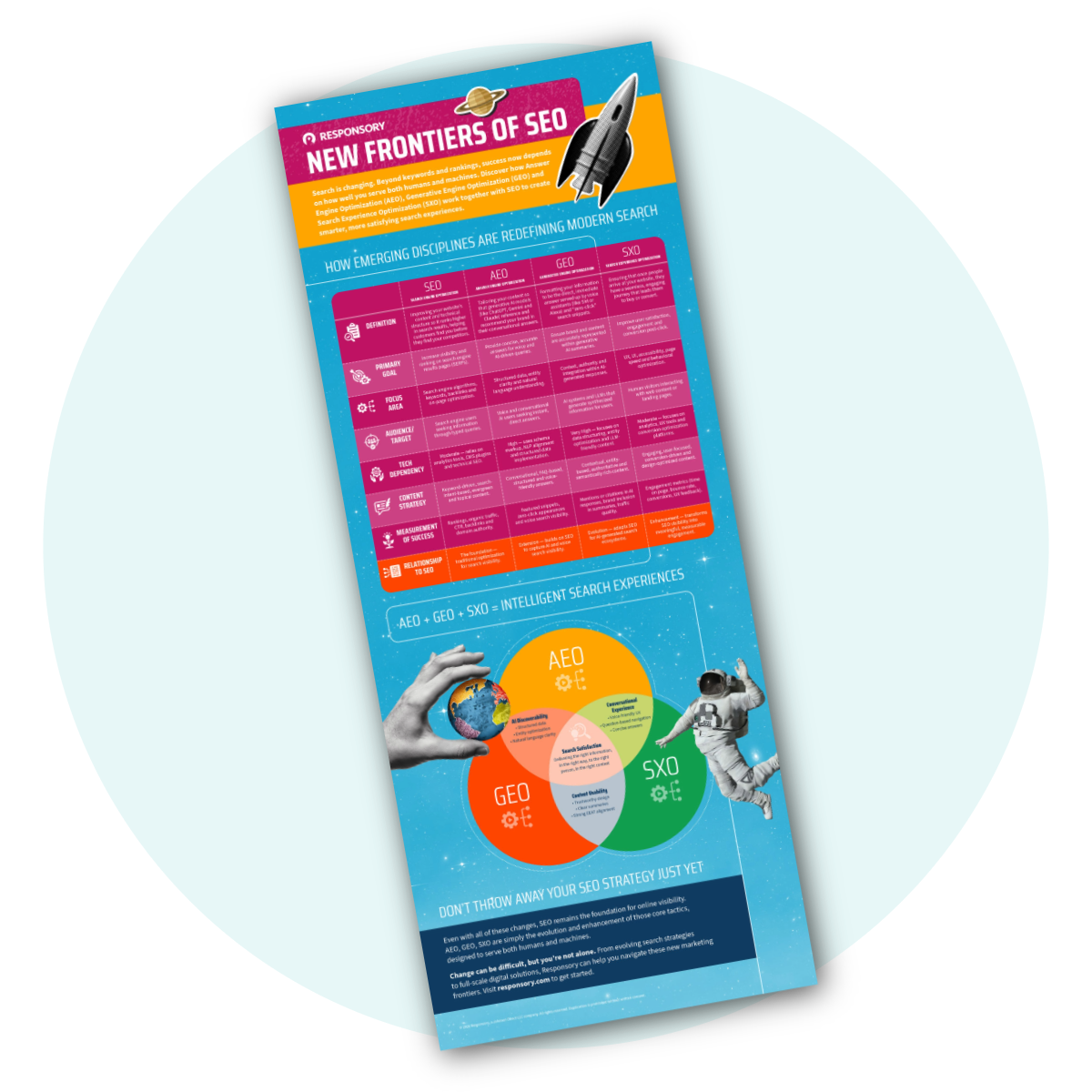
Free Infographic
AEO, GEO & SXO: The New Frontiers of SEO
Search is changing. Beyond keywords and rankings, success now depends on how well you serve both humans and machines. Discover how Answer Engine Optimization (AEO), Generative Engine Optimization (GEO) and Search Experience Optimization (SXO) work together with SEO to create smarter, more satisfying search experiences.