Your Google Reviews Are a Ranking Signal – Here’s How to Start Treating Them Like One
Your website’s job is to turn visitors into customers, but before they ever click through, they look at your Google reviews. Discover how customer feedback impacts your local SEO ranking and the best practices you need to follow to transform your Google Business Profile into a local search powerhouse.
Most businesses think of Google reviews the way they think of a tip jar – nice when it fills up, but not essential to operations. That mindset is costing them customers they never knew they lost.
Here’s the reality: Google reviews are one of the most powerful and underutilized marketing levers available to regional and multi-location businesses today. They don’t just manage your reputation; they dictate where you show up in search results, whether an AI tool recommends you, and whether a voice assistant even knows you exist.
At their core, both search algorithms and AI engines are trying to answer one simple question: Which business best solves this user’s problem? And reviews can provide the real-world, third-party signals needed to answer that question. But to win over today’s algorithms, your review consistency, relevance and trustworthiness are key.
Let’s break down why reviews are so important to local search rank – and how you can make reviews part of your process.
The SEO Connection: Local Search & the Map Pack
If you’ve ever searched for a service, you’ve seen the Local Pack (often called the Map Pack) – the map and three business listings that appear at the very top of Google’s search results. For local businesses, appearing in that spot is often more valuable than a top organic ranking. It’s the first thing users see, and it’s where the majority of clicks go.
Google uses a combination of three core factors to determine these Local Pack rankings: distance (how close your business is to the searcher), relevance (how accurately your business matches what they’re looking for) and prominence (how well-known and trusted your business is).
While you can’t control distance and the algorithm determines relevance, your Google Reviews can directly build your prominence. Specifically, the algorithm evaluates your review profile based on four key metrics:
- Volume and Recency. A review from three years ago carries little weight today. A steady stream of fresh reviews signals to Google that your business is active and reliable right now.
- Star Rating and User Behavior. A higher average rating drives more clicks. Google tracks this high click-through rate as user engagement, which tells the algorithm to rank you even higher.
- Keyword-Rich Content. When customers naturally mention specific services, neighborhoods or personnel, they generate organic keyword signals that help search and AI engines corroborate what you do and map your business to relevant user queries.
- Response Speed. Google explicitly rewards engaged businesses. Replying to reviews quickly (ideally within 24-48 hours) acts as a direct ranking signal, as well as a trust signal for prospective buyers reading your profile.
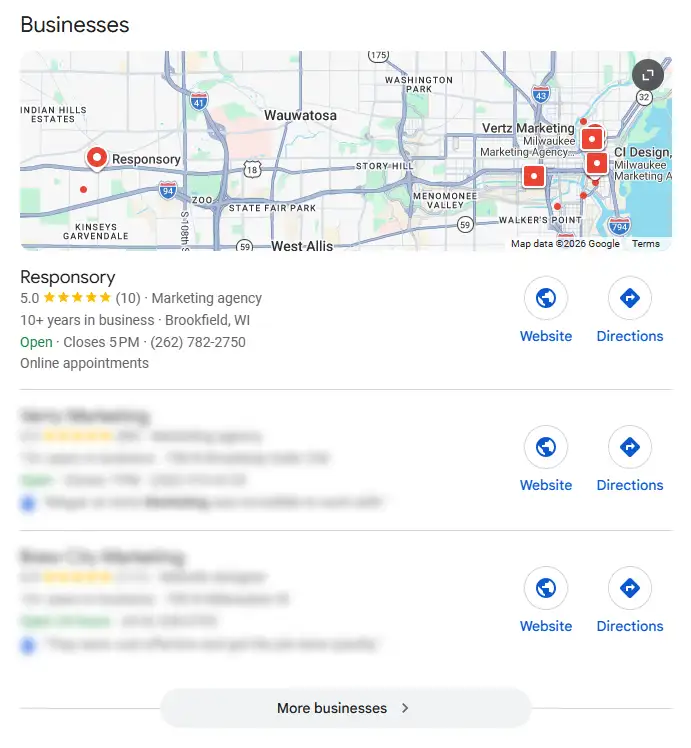
Example of map pack search results showing listings linked to Google Business Profiles.
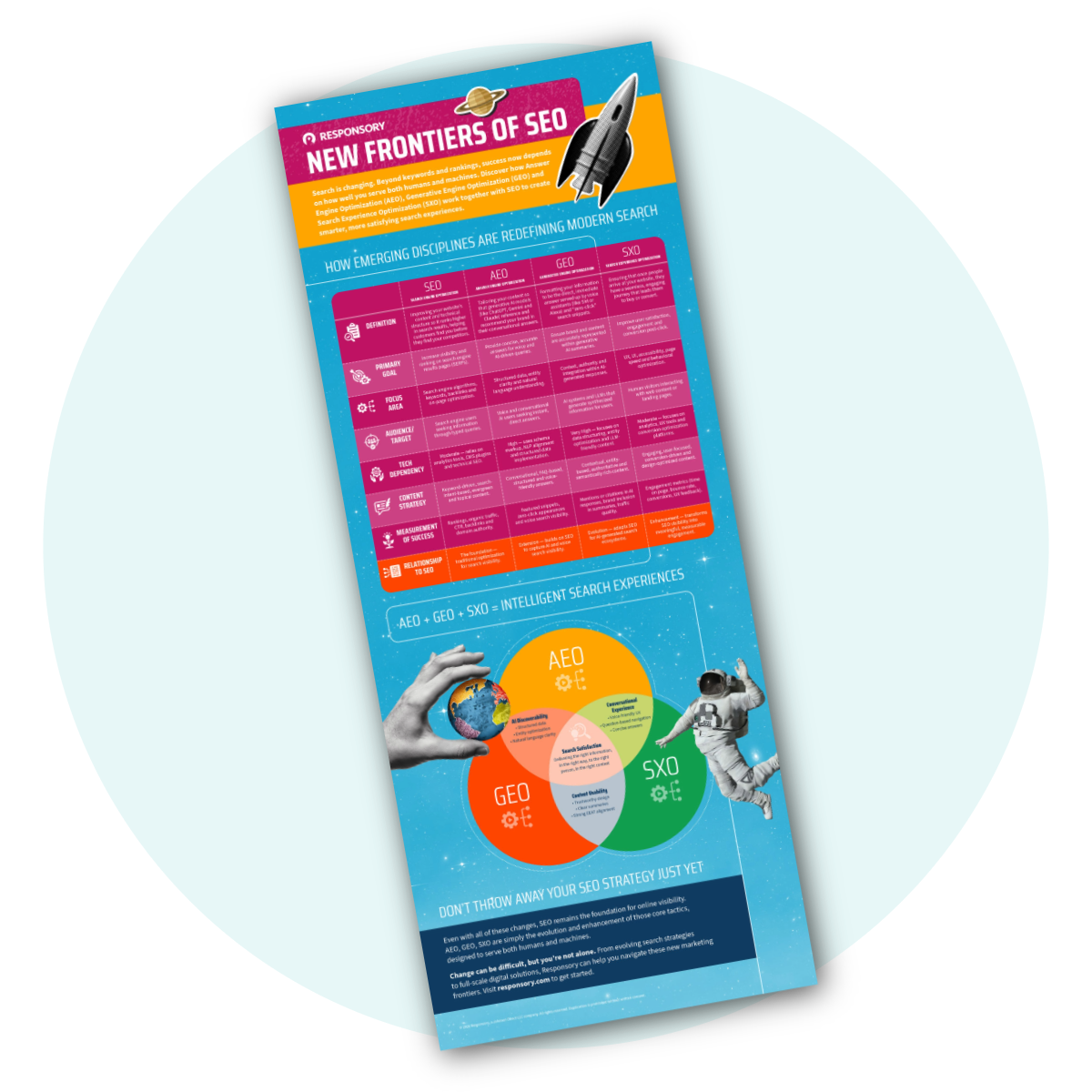
How Reviews Influence AI-Generated & Zero-Click Search Results
If traditional SEO is about climbing a list of links, modern search is has expanded into Answer Engine Optimization (AEO) – being the single, definitive answer a voice assistance or snippet presents – and Generative Engine Optimization (GEO) – ensuring your brand is cited in answers generated by AI like Gemini, ChatGPT and Claude.
They may sound like completely different problems, but for your review profile, the assignment is exactly the same.
When a user asks Google, Claude or Alexa a question like “What’s the best mechanical contractor near me?,” the algorithm doesn’t just scan a website. It draws on signals from across the web, relying heavily on natural language and sentiment patterns found in your Google Reviews to make a trust judgement.
The stakes are highest in voice search and audio AI responses, which are winner-take-all. When a smart assistant reads an answer aloud, there is no second result. No runner-up. If your business hasn’t accumulated enough trust signals to be the recommended answer, you’re invisible to that query entirely and the buyer moves on without ever knowing you existed.
Zero-click searches work the same way. From the latest data, 68% of all searches now end without a single click, as Google answers user intent directly on the results page via knowledge panels and AI summaries. Because Google is keeping the user on its own interface, it takes on the reputational risk of recommending you. It uses your review history as an insurance policy to validate that you are a legitimate, operational and highly trusted business.
What this means practically: the content of your reviews matters as much as the count. Detailed reviews that mention specific services, locations and outcomes give AI models more material to work with, and more reason to recommend you over a competitor with a higher volume of generic five-star ratings. This is why coaching your team to invite specific, descriptive feedback pays dividends that go beyond a star rating bump.
Building a Review Strategy That Actually Works
Understanding why reviews matter is step one; building a sustainable process to collect them is where most businesses stall. To consistently feed both search and AI engines, you need a practical framework:
1. Ask At the Right Moment
Generic requests get ignored. The most effective approach is a direct, human ask, ideally by the team member who did the work. Encourage your staff to use language like: “I’m glad we could get this resolved for you today. Would you mind mentioning my name in a quick Google review? I can text you the direct link right now.” Reviews that mention team members by name are more credible, more specific and more useful to Google’s relevance algorithms.
2. Deploy Multi-Channel Touchpoints
Meet your customers where they’re easiest to reach – and most willing to act. Text (SMS) tends to have the highest conversion rate for field service work. Email works well for project managers and B2B stakeholders, especially when paired with a personalized thank-you note and a direct review link. QR codes on leave-behind cards, service reports or technician clipboards give clients a frictionless path to review on their own time.
3. Respond to Everything Within 48 Hours
Every review deserves a response, whether positive or negative. For positive reviews, thank the client, name the specific service or project and weave in your location naturally. For example: “Thanks, [Name]! Our Milwaukee mechanical team loved working on the [Project Name] installation – we’re glad everything went smoothly.” That kind of response reinforces location and service keywords in a way Google values. For negative reviews, stay professional, don’t get defensive and move the conversation offline. A public, measured response to a negative review is often more persuasive to prospective clients than a string of five-star reviews because it shows accountability.
4. Never Gate, Incentivize or Instruct
Don’t screen customers before sending the review link – the link goes to everyone. Don’t offer discounts, gift cards or anything of value in exchange for a review. And never tell someone to only leave a review if it’s five stars. All of these practices violate Google’s Terms of Service and can result in the removal of your entire Business Profile. Furthermore, the FTC heavily penalizes deceptive review practices and incentivized feedback – violations that you probably don’t want to find out about the hard way.
Your Reviews are a Strategic Asset – Use Them!
For multi-location and regional businesses, every location’s review profile is either earning or giving up ground in local search. The good news is that this is one of the most controllable variables in your digital marketing mix. You don’t need a huge budget increase; you just need a consistent process, a trained team and the discipline to make review collection as routine as closing a work order.
And once you build that momentum, don’t let it sit on Google. Your reviews can be highly persuasive sales collateral and one of the few marketing assets that gets created for free by people who aren’t you. Put them to work by:
- Embedding Live Widgets on location-specific website pages and service landing pages so prospects can see real-time social proof right at the moment they’re deciding to convert.
- Supercharge Proposals by pulling in reviews that match the prospects industry, service type or region. Let your happiest clients be the proof that you’re good at what you say you’re good at.
- Create Social Proof Assets by transforming your most detailed, narrative-rich reviews into branded social content. Highlighting a quote that praises your local team’s speed or technical expertise is far more compelling than a generic promotional post you’d write yourself.
The businesses showing up at the top of the Map Pack, in AI Overviews and as the voice assistant’s recommended answer aren’t there by accident. They’ve treated their review presence as the strategic asset it is – and they’re reaping the rewards across every channel.
Ready to make your Google presence work harder? Responsory helps B2B and multi-location businesses build digital authority through smarter local SEO, content strategy and reputation management. Get in touch today to get started.
A Note From the Cobbler
We’d be remiss not to acknowledge the obvious: we’re a marketing agency telling you how important Google reviews are… and our own Google review presence could use some work. Classic cobbler’s kids have the worst shoes situation.
Turns out it’s a lot easier to build a review program for your clients than to carve out time for your own. We know the playbook (we helped write it) and we’re as guilty as anyone of letting “ask for a review” fall to the bottom of the to-do list when client work is at the top.
So here’s us practicing what we preach: if we’ve worked together and we’ve earned it, we’d genuinely appreciate a Google review. It takes about 90 seconds, it helps us more than you probably realize, and frankly it keeps us honest.

About the Author
As Director of Digital Services, Ivana Skoko brings over two decades of digital marketing know-how to the team. Equal parts strategist and optimizer, she’s always fine-tuning campaigns, obsessing over data and asking “what if we tested this?” With deep expertise in SEO, paid media and e-commerce, her digital roadmaps are built to perform and evolve with each client’s unique goals. Off-screen, she’s a meme maven known for bringing sharp ideas and sharp wit to every collaboration.